


Transparent vs Diffused LED Lens: 20 mA Brightness Difference
With the same die and the same forward current, clear-lens and diffused-lens LEDs can differ several times in on-axis brightness. This article explains the loss mechanisms, gives comparable data, and estimates the cost of matching brightness.
Chinese version: LED灯珠透明胶体与雾状胶体亮度差异:同样20mA,为什么正面发光强度能差3–4倍?
30-second summary
Conclusion: At the same die and current (e.g., 20 mA), a diffused lens typically delivers only 25–35% of the on-axis luminous intensity (mcd) of a clear lens, while the gap in total luminous flux (lm) is much smaller — light is spread over a wider angle, not lost.
Key data: clear lens transmission typically ≥95%, beam angle 15°–60°; diffused lens transmission typically 60%–85%, beam angle 100°–140° (industry typical values; test conditions in Section 3).
Cost: matching the apparent brightness with a diffused lens typically adds 12–35% per LED; mainstream approach is about 15–20%.
Scope: these are industry ranges; confirm with the model datasheet and integrating-sphere measurement.
1. What Are Clear and Diffused Lenses?
LED encapsulation falls into two families: clear lenses aiming for high transmission and narrow beams, and diffused (milky) lenses using diffuser powder for soft, wide-angle output.
| Item | Clear lens | Diffused (milky) lens |
|---|---|---|
| Compound | Pure epoxy / silicone | Epoxy / silicone + diffuser (SiO₂, PC diffuser powder, etc.) |
| Appearance | Transparent, die and gold wire visible | Milky, frosted |
| Transmission (typical) | ≥95% | about 60%–85% |
| Typical beam angle | 15°–60° (narrow) | 100°–140° (wide) |
| Spot appearance | Bright core / hot spot | Soft, uniform, no hot spot |
| Typical use | Indicators, traffic lights, flashlights, spotlights | 7-segment displays, panel lights, ambient lighting, backlight |
Note: transmission and beam angle vary with lens thickness, wavelength and lead-frame design; the ranges above are common in LED packaging.
2. Where Does the Difference Come From? Three Loss Mechanisms
With the same die and the same forward current (IF = 20 mA), the difference comes from three effects:
2.1 Scattering loss (main cause)
Diffuser particles have a different refractive index from the encapsulant, so light undergoes multiple Mie scattering events. The light is redistributed over a larger solid angle, which lowers the intensity per steradian (mcd) — this is why "total flux hardly drops, but the LED looks much dimmer head-on."
2.2 Total internal reflection and re-absorption
Some scattered rays hit the lens surface beyond the critical angle, are reflected back into the package and eventually absorbed by the lead frame or die, turning into heat.
2.3 Material absorption
Diffuser powder and the encapsulant absorb a small amount of light; higher haze and higher diffuser loading increase the loss and reduce transmission.
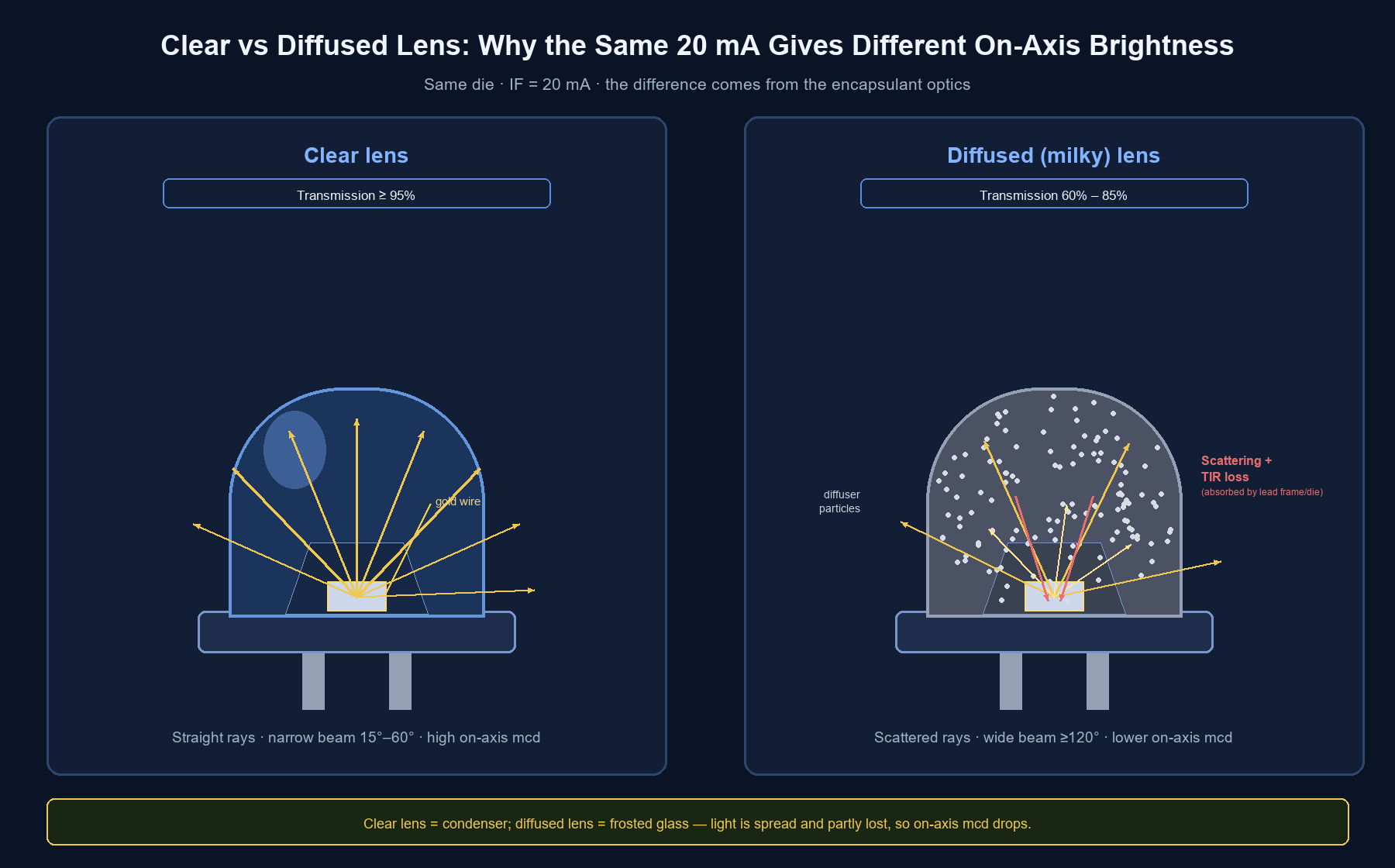
In one sentence: a clear lens acts like a condenser that bundles light; a diffused lens acts like frosted glass that spreads it. Since mcd measures light per direction, spreading the light lowers on-axis brightness.
3. Reference Data: Same Die, Different Lenses
Test conditions: Ta = 25 °C, IF = 20 mA constant current, same die lot (Grade-A square die), n ≥ 5 samples, integrating sphere + illuminance meter. Values below are industry typical relative values, not a single-model test report; refer to the datasheet binning data.
| Package / lens | Beam angle | Relative luminous intensity (mcd; clear 15°–30° = 100%) | Visual effect |
|---|---|---|---|
| Clear lens (narrow 15°–30°) | 15°–30° | 100% (reference) | Bright hot spot, visible at distance |
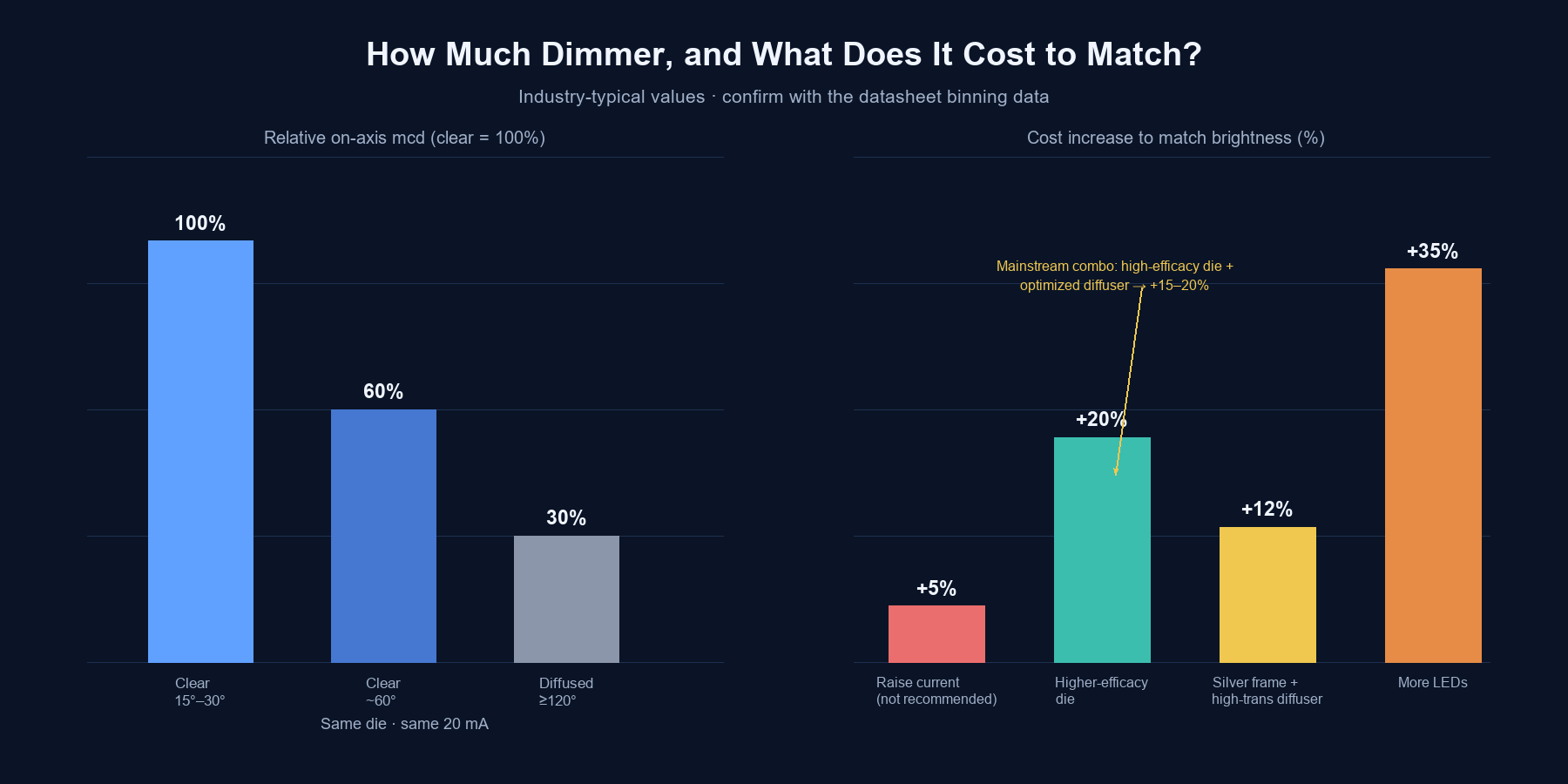
| Clear lens (standard 60°) | about 60° | about 50%–65% (experience value, depends on radiation pattern) | Bright with directivity |
| Diffused lens (120°) | ≥120° | about 25%–35% | Soft and uniform, comfortable up close |
Note: actual values depend on die size, die grade, lead-frame material (silver vs alloy), bonding wire (gold vs copper) and compound formulation; the gap in total flux (lm) is usually much smaller than the gap in mcd.
4. What Does It Cost to Match Brightness with a Diffused Lens?
If a diffused lens is required (for soft, wide-angle output) and the apparent brightness must match a clear lens, there are four common routes:
Cost ranges below are 2026 experience estimates for South China LED packaging; actual prices depend on die brand, packager and order volume.
| Option | Principle | Cost increase (estimate) | Trade-off |
|---|---|---|---|
| 1. Increase drive current | Raise IF (e.g., 20 → 30 mA) | about +5% (driver cost) | Higher junction temperature, faster lumen depreciation, shorter life; not recommended long-term |
| 2. Higher-efficacy die | Larger die or higher-brightness bin | +15%–25% | Most common and robust way to gain brightness |
| 3. Upgrade materials | Silver lead frame + high-transmission diffuser + imported compound | +10%–15% | Requires joint sampling with the packager |
| 4. More LEDs | Compensate with quantity | +30%–40% | PCB area and placement cost rise accordingly |
Bottom line: without sacrificing lifetime and reliability, matching a clear lens with a diffused lens typically adds 12–35% per LED; the mainstream approach (higher-efficacy die + optimized diffuser loading) lands at 15–20%.
5. Selection Guide
Choose a clear lens if you need:
- High-brightness indicators (power/status, visible at distance)
- Narrow-beam lighting (flashlights, spotlights, floodlights)
- Low-power designs (maximum brightness per mA)
Choose a diffused lens if you need:
- Soft, glare-free display (7-segment, instrument backlight, ambient light)
- Wide, uniform output (panel lights, strips, light boxes)
- Hidden hot spots and consistent appearance (appliance panels, consumer electronics)
A practical compromise: use a clear-lens LED plus an external diffuser plate. The diffusion is handled by the structure, the LED keeps high efficacy, and the total cost is often lower than a high-brightness diffused LED.
6. FAQ
Q1: Is a dimmer diffused LED using a worse die?
No. The difference comes mainly from lens optics, not die quality. Judge die quality by die size, efficacy (lm/W), lumen maintenance and ESD rating, not by lens clarity.
Q2: Can we reduce diffuser loading to balance haze and brightness?
Yes. Diffuser loading is a core formulation parameter; a low-load "semi-diffused" version can reach 85–90% transmission with less haze and noticeably higher brightness — a cost-effective compromise.
Q3: Does the same rule apply to white LEDs (blue die + phosphor)?
Yes, and the difference is usually larger. In a white diffused lens, phosphor and diffuser scatter light twice, so transmission loss is more pronounced; always confirm with datasheet flux data.
Q4: Do SMD LEDs (2835/5050/0603) also come in clear and diffused versions?
Yes. SMD LEDs control output through lens haze and lens shape (flat, dome, concave); the physics is the same as through-hole LEDs.
Q5: How to tell a clear lens from a diffused one quickly?
Look against the light: if the die and electrodes are visible, it is a clear lens; if the package is milky and opaque, it is diffused. When lit, a clear lens shows a bright hot spot, while a diffused lens looks soft and uniform.
Related Pages
- Datasheet Center (375 PDFs)
- 0603 SMD LED series
- 2020 six-pin addressable RGB LED
- Quality & Certifications
Author: Hongcheng Optoelectronics Application Engineering Team | Reviewed by: Packaging Engineering | Updated: 2026-11-20 | Company: Dongguan Hongcheng Optoelectronics Co., Ltd (member of GTY Group)
Data are industry-typical values for education and selection reference only and do not constitute a performance commitment for any model. Confirm against the supplier datasheet and measured samples.


